Transport Setup
General
Use the Transport Setup page to configure the basic operation of the TMS module. The settings on this page apply to the whole company and affect orders, sections, trips, and activities, as well as revenue and cost calculation.
Set up Transport Setup before you create the first order. Several settings depend on other master data that must exist first, such as status templates, number series, activities, and units of measure. Some settings can be overridden per plan department or per order type.
Functionality
The Transport Setup page groups related settings on FastTabs: General, Order Defaults, Agreements & Pricing, Planning, Unit of Measure, Extra Unit of Measure, Capacity, Calculation, CMR, Numbering, Status Template and Integrations. Some FastTabs contain smaller groups, for example Default Confirmations on the General FastTab. Hover over a field to read its tooltip.
To open a related list or setup page from the Transport Setup page, use the Navigate menu. It contains these groups:
| Group | Opens |
|---|---|
| Status Templates | Status Templates |
| Agreements & Pricing | Fuel Clauses, Toll Clauses, Contract Strategies, Contract Strategy Log, Fuel Quantity Calculations, Cash On Delivery Agreements |
| Planning | Activities, Sequence Calculation Methods, Order Types, Day Periods |
| General | Calendars, Invoice Info. Descriptions, Address Setup |
| Unit of Measure | Unit Setup, Units of Measure |
| Resource Dispatcher | Resource Dispatcher Setup |
Tab: General
The basic settings for the transport setup, including the Default Confirmations and Dimension Validation groups.
Actions
Unit Setup: initializes the unit setup. Don't run this action in a production environment.Resource Dispatcher Setup: initializes the setup on the Resource Dispatcher.RelatedTMS Event & Milestone Setup: initializes the setup on the Events & Milestones.
Fields
Base Calender Code: The default calender to be used.Get From or To Address from Order Type: -Multiple Time Zones in System: When enabled, all regular dates and times are considered to be in UTC. Local Dates are in the Time zone of the corresponding Address.
Default Confirmations
Default From Address Confirm Answer: Specifies if the: From Address on a Trip has to be overwritten with the value: Default Site as set on the Truck, when assigning a Truck to a Trip. Options: Yes, No and Empty(users will have to select an answer on each assignment).Default To Address Confirm Answer: Specifies if the: To Address on a Trip has to be overwritten with the value: Default Site as set on the Truck, when assigning a Truck to a Trip. Options: Yes, No and Empty(users will have to select an answer on each assignment).Track Trip To Address No. Changes: Specifies whether manual changes to the To Address No. have to be tracked for trips based on the previous value. Options: Previously Not Empty and Always.Default Overwrite Resource with Assignment Answer: Default answer to the confirm question whether already filled resources should be overwritten by assigned resources. If left empty, the question has to be confirmed manually.
Dimension Validation
Weight Validation: Specifies the validation priority when entering net, gross and tarra weight. Options: Default(Adjust tarra weight if both gross and net weight are filled) and Tarra(Retain tarra weight if possible).Volume Validation: Specifies the way Volume is determined. Default(Volume is just the total volume of the goods) and Incl. Handling Unit(Volume is total volume of goods and handling unit).
Tab: Order Defaults
Defaults applied when you create and process new orders. This FastTab was previously named Order.
Fields
Lead Time Warning: -Unloading Date Calculation Method: Option to determine the automatic calculation of the unloading date when manually entering an order.Default Unloading Date: For next day: 1D.Default Start Time: When no opening times or time slots are registered on an Address, this value will be used in the order.Default End Time: When no Opening Times or time slots are registered on an Address, this value will be used in the order.Reuse Customer Reference: Option to determine whether a Customer Reference on an order can be used more than once.Reuse Customer Reference (Posted): Option to determine whether a Customer Reference on a posted order can be used more than once.Reuse External Document No.: Option to determine whether an External Document No. on an order can be used more than once.Reuse External Document No. (Posted): Option to determine whether an External Document No. on a posted order can be used more than once.Default Trip Order Type: This trip order type will be applied automatically to new Trips.Skip Default Sell-To-Contact No.: -Delete Sub Document Line: Specifies what to do with the Order when the last Sub Document Line is deleted. Options: Keep Order and Delete Order.
Tab: Agreements & Pricing
Defaults used when calculating agreement and contract revenue and costs, and when invoicing. The settings for Contract Strategy are in the Contract Strategy group at the end of this FastTab.
Fields
Rate Calculation With Manual Lines: Specifies how the system must act when manual revenue lines have been entered on an Order. Options: Keep Manual - Add All, Keep Manual - Add Surcharge and Discount, Keep Manual - Add None, Delete Manual - Add AllLine Amount Editable: Specifies if users are allowed to edit the amount on an automatically generated revenue/cost-line. : Error, Warning, Allowed.Contract Customer Not Found: Specifies how the system must act when performing Calculate Revenue or Execute Contract Strategy on an Order and no Contract can be found . Options: Notification, Message, Error, Nothing.Contract Vender Not Found: Specifies how the system must act when performing Calculate Revenue/Costs or Execute Contract Strategy on a Trip and no Contract can be found . Options: Notification, Message, Error, Nothing.Revenue Posting Date: Specifies what date to be used on Posting Revenues. Options: Document Date, Order Date, Posting Date, Loading Date, Unloading Date, Actual Loading Date, Actual Unloading Date, Actual or Requested Loading Date, Actual or Requested Unloading Date, Loading Date(Local Date), Unloading Date(Local Date), Actual Loading Date(Local Date) or Actual Unloading Date(Local Date)Contract Price Search: What date is to be used when determining which Contracts Detail Lines is applicable on an Order when calculating revenues. Options: Document Date, Order Date, Posting Date, Loading Date, Unloading Date, Actual Loading Date, Actual Unloading Date, Actual or Requested Loading Date, Actual or Requested Unloading Date, Loading Date(Local Date), Unloading Date(Local Date), Actual Loading Date(Local Date) or Actual Unloading Date(Local Date)Invoice Info Description Code: Functionality to add additional information to Sales Invoice Lines.Advances Fuel Clause Surcharge: Advanced fuel clause feature that provides the option to define a base price and additional information to calculate the fuel surcharge percentage for the next period.';Keep Surcharge Lines: Turn on to keep the surcharge lines from every evaluated contract when you run Execute Contract Strategy. When off (default), only the surcharge lines of the last evaluated contract remain. See Contract Strategy.
Contract Strategy
Contract Strategy Nos.: The number-series to be used when creating new Contract Strategies.Contract Strategy Logging.: Options: Disabled(Default) and Enabled: Switch to this value to enable logging. This will affect the performance of the calculation of revenues.No Cust. contract fallback when using Contract Strategy: Options:
- Disabled: If no revenue can be determinated based on the Contract Strategies linked to the Customer the system will determinate revenues based on a General Contacts Strategy.
- Enabled: the system will not revert to a General Contacts Strategy.
Tab: Integrations
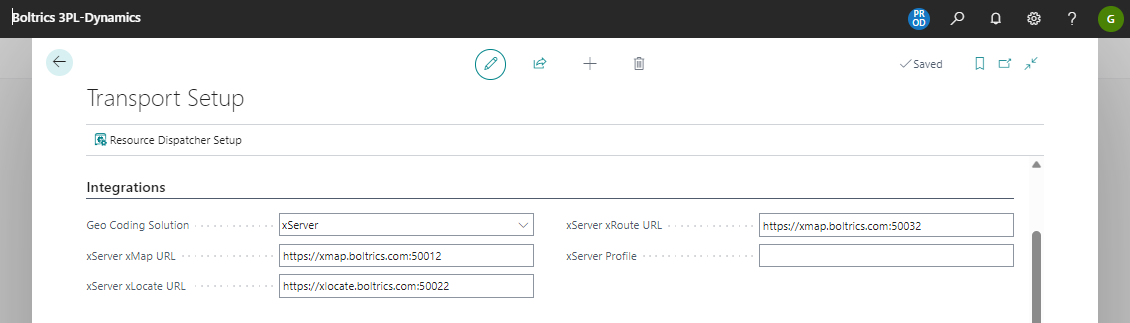
The setting for integrating with PTV for geocoding addresses and calculating distances and driving times on sections and trips.
Fields
Geo Coding Solution: Default value: Geocoding By Address (PTV)) or Geocoding by Text.xServer Profile: A default PTV Vehicle Profile can be set, to be applied on Trip when no truck with a PTV Vehicle Profile has been planned on the TripRoutering Request Logging: Default value: Disabled. Can be changed to Enabled to turn on logging.
Tab: Status Templates
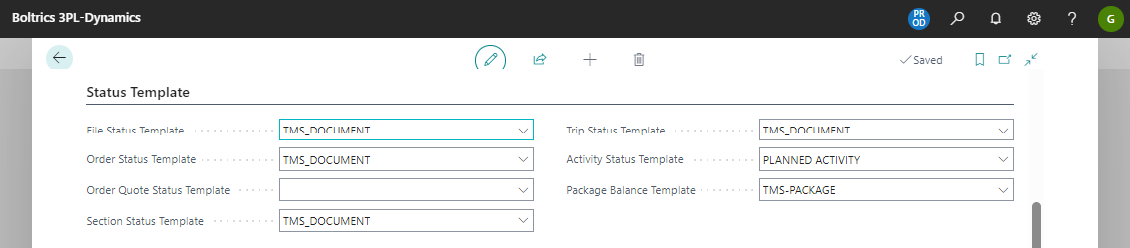
The settings on which status template is applicable on what TMS-document.
Tab: Numbering
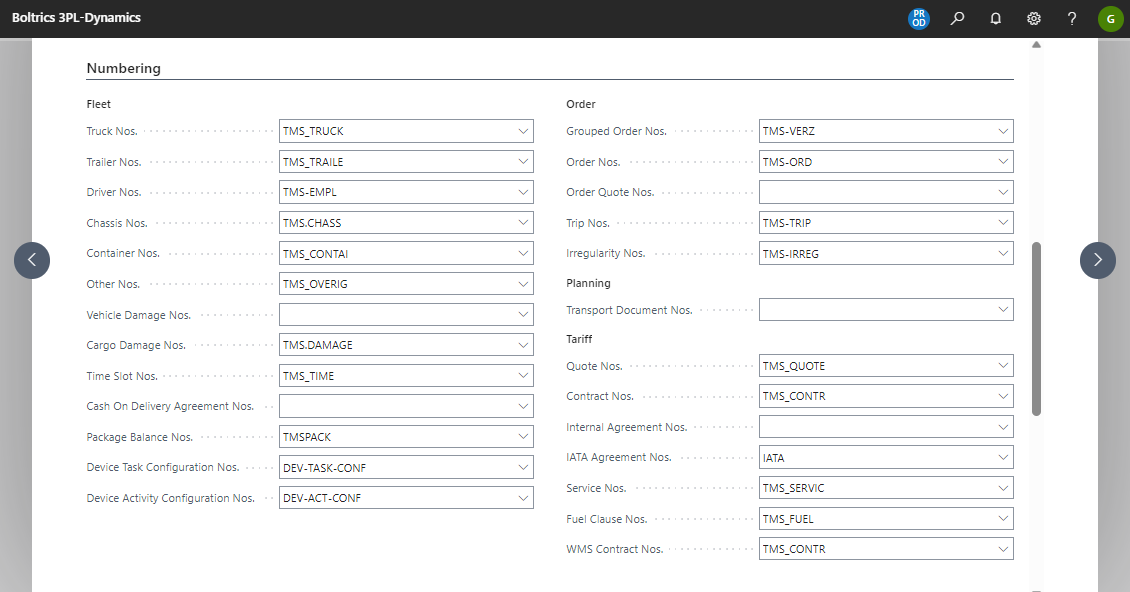
The numbers to be used automatically or manually on an entity. By clicking through on the values it is possible to set up your own number series for different periods(years).
Tab: Unit of Measure
Settings on which codes apply to the various Unit of Measure on the goods lines of an order
The standard units can be set for use in the ordering- and planning process. On the 1st line, select the code applicable to the description. On the 2nd line a weight conversion can be entered so that a payweight can be calculated on orders. If there are multiple units that apply to the same description, for example PALLET and BLOKP then a conversion has to be added to the Unit of Measure.

Tab: Extra Unit of Measure
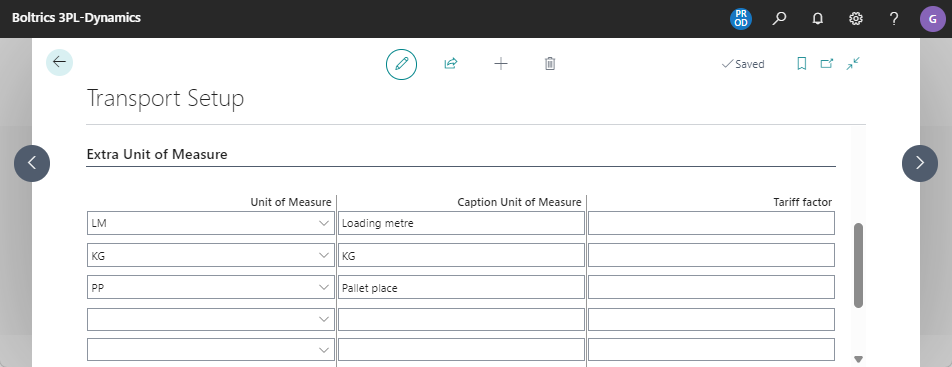
The Values set on this tab will be calculated/shown in the Visual Planning, Window: Planned Sections. These values can be shown as Balance-totals and Percentage-Utilisation.
Tab: Planning Units
The standard planning units for capacity-settings on resources and load factor calculation on trips.
set in this tab will be shown as extra Settings on which Unit of Measure on Orders, Sections and Trips have to be aggregated for planning and contract purposes.
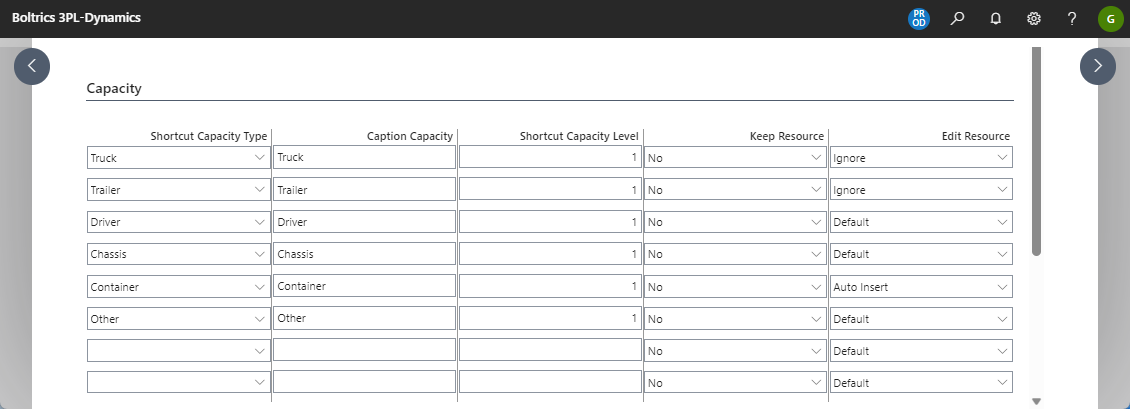
Tab: Capacity
More info will follow.
Tab: Planning
Settings on the planning functionality. The FastTab is split into groups for trips, sections, activities, grouped orders and route text.
Fields
Skip Collect Plan Restrictions: Options: True and False(Default value).Disable Calendar Management: Options: True(Default value) and False.Disable Dime: Options: True(Default value) and False.
Trip Characteristics
Default Trip Starting Time: The value will be applied as the start time for all new Trips. User can change the starting time on a Trip.First Load Activity is Start Time: True: The start time of the Trip will be calculated based on the requested start date and time of the first Section planned on the Trip. The system will take into account norm-times and the driving-time between the start of the trip and the Address of the first Activity. False: The start time will be based on the previous field: Default Trip Starting Time or the time entered manually.Default Average Speed: The value to be used when calculating driving times on a Trip if no route-calculation can be made based on the Vehicle Profile.Allow Random Completion order: Options: True(Default value) and False(all activities with a lower trip stop sequence will be finished automatically).
Section Update Characteristics
Section Split Method: Options:
- Loading Date: the date of splitting will be coppied from the field: Loading Date From from the Section.
- Unloading Date: the date of splitting will be coppied from the field: Unloading Date From from the Section.
- User Section: the user will have to confirm the date of splitting when splitting manually.Section to Address Update: Options: Crossdock or Update Order Address(Default value).Section Split Trip: Options:
- User Selection: user will have to confirm what option is applicable when splitting manually.
- Assign to Current Trip: The newly created Section will be planned on the current Trip.
- Do not assign to trip: the newly created Section will be avaible as unplanned section.Section Split Comments: Options: Copy All Comments To New Section(Default value) and More Unload COmment to New Section.Keep Loading From-To equal: Options: True and False(Default value).Keep Unloading From-To equal: Options: True and False(Default value).
Trip Activity Calculation
Combine Shipments in Activity: Yes: will combine planned sections by Activity/Address. No: will result in separate Planned Activities for each Section planned on the Trip.Update Address from Trip: -Update Actuals From Activity: -Default Activity Calculation: Options:
- Default.
- Milk Run: Apply when only Milk Run Trips are applicable.
- Manual Activities, default value.Default Activity Improver: Options: PTV Developer or PTV Developer - Per ActivityCalculate Emission direct with Activity Calculation: Options: True(Default value) and False.
Sequence Calculation
Sequence Calculation Method Code: -Sequence Calculation Method: Options:
- Groupage: first all loading activities will be planned and then followed by all unloading activities.
- Container/FTL: Activities will be planned per - Section.
- Distribution: -.Sequence Calculation Step: The automatic sequence on each new loading or unloading activity will be increased by this value.
Activities
Activity No. Loading: The Activity to be applied on loading activities.Activity No. Unloading: The Activity to be applied on unloading activities.Activity No. Driving: The Activity to be applied on driving activities.Activity No. Resting: The Activity to be applied on resting activities.Activity No. Tripstart: The Activity to be applied on the trip-start activities.Activity No. Tripend: The Activity to be applied on the trip-end activities.Activity No. Employee pick up: The Activity to be applied on the employee pick up activities.Activity No. Employee drop off: The Activity to be applied on the employee drop off activities.Activity No. Trailer Couple: The Activity to be applied on the trailer couple activities.Activity No. Trailer Uncouple: The Activity to be applied on the trailer uncouple activities.Activity No. Truck Couple: The Activity to be applied on the truck couple activities.Activity No. Truck Uncouple: The Activity to be applied on the truck uncouple activities.Activity No. Couple: The Activity to be applied on the couple activities.Activity No. Uncouple: The Activity to be applied on the uncouple activities.Activity Empty Drive: The Activity to be applied on when driving activities without cargo loaded.
Grouped Orders
Prevent Update Grouped Sell No.: Options: True and False(Default value).Assign Remaining Line Amount: Options: True(Default value) and False.
Route Text
Route Text Provider: Specifies how the route text will be generated. This setting can be overridden on Plan Department.Route Currenct Location identifier: Specifies the identifier used to show where the route is in the text as show in the Trip. If left blank, no location identifier will be shown.Route Text Only Based on: When true, the route text is based on the activities which are marked as "Use in RouteText" in the Activity List.
Tab: Calculation
Settings related to both estimated and revised calculating revenue and cost on Orders and Trips

Tab: CMR
Setting to add special instructions on the CMR in box 16. Depending on the function set selected, the comment lines related to the transport order are printed. e.g. loadingreference-comments, unloadingreference-comments or the Goods comments.
