Order
General
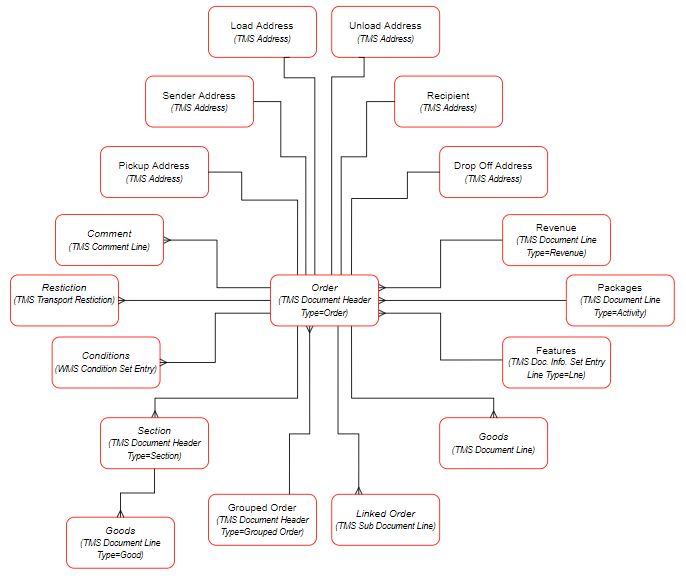
An order records an agreement with a customer: which goods are transported from A to B, and on which date. The order is the starting point of the TMS process. When you release it, TMS creates the sections that you plan on trips, and the revenue lines that you invoice. For the complete process, see Status templates for transportation.
Functionality
Tabs
The order page consists of a number of tabs. Depending on the personalization settings, not all tabs are shown automatically to each user or role.
| Name | Description |
|---|---|
| General | Among other things, the client, order type, date and status are recorded here. |
| Container | If the order concerns the transport of a container, the specific details of the container can be specified here. The container number and type are recorded on the Lines. |
| Shipping | The sender, loading address, requested loading date and time, recipient, unloading address and requested unloading date and time are recorded here. |
| Lines | The lines of goods to be transported are defined here. |
| Package | The lines of packages to be exchanged. |
| Revenues | The revenue lines to be charged to the customer. |
| Costs | If specific costs apply to the order |
| Invoicing | Based on the settings on the customer, these fields are filled automatically. If required, values can be changed. |
| Track Trace | The information relating to the realization of the order . |
| Additional loading/unloading addresses | The additional loading and/or unloading addresses that apply. Adding a line will add a new linked-order automatically. |
Fact boxes
A number of fact boxes can be displayed in which additional information applicable to the order is shown. Depending on the personalization-settings not all Fact-boxes will be shown automatically to each user/role.
Factboxes
Parties: A list Parties with Contacts which are applicable on the Order.Customer Statistics.: A number of values related to the Customer of the Order for example the Total Balance.Steps:The Steps related to the order.Additional step: The additional steps related to the Order.Order; Some values of the order, for example, the totals of the planning units of the goods lines.Restrictions Loading: The Restrictions applicable to the loading address.Restrictions Unloading: The Restrictions applicable to the unloading address.Cash on Delivery: The Amounts applicable on the Order if Cash On Delivery is applicable.Invoicing: The totals of Revenues and Costs on the Order.Calculation: The revenues and costs at different phases of the Order.Record Links Webclient: The documents linked to the Order, e.g. the e-mail containing the order or the signed POD-document.Links (incl. documents): The linked documents on the Order. When an WMS-TMS integration is realized also links based on the related WMS-Receipt or WMS-Shipment will be shown.
Definitions
Load meters
Load meters are often used in road transport. A 1 load meter is equal to 1 linear meter of cargo space in the truck/trailer. An euro pallet (80x120 cm) is 0,4 load meter and 1 block pallet (100x120 cm) is 0,5 load meters.
Payable weight
The payable weight is the maximum value of the Gross Weight, the Volume multiplied by the volume conversion factor and the Load meters multiplied by the load meter conversion factor. The default conversionfactors are set in the Transport Setup. Tab: Unit Of Measure. Often a volume conversion of 300 kg and load meter conversion of 1.750 kg is applied. If desired, you can set specific conversion factors per contract line. On the contract line, turn on Use WeightFactors and enter the factors on the tab Tariff Quantity Norm. TMS then calculates the payable weight of each goods line as the highest value of the quantity per planning unit multiplied by the weight factor of that unit. If you also enter a Minimum Payable Weight, the payable weight is at least that value. The paying weight gives the possibility of calculating the matching revenues based on a real load.
Divided revenues or costs
When TMS divides revenue or costs over orders or sections, for example for a grouped order, it does so on the basis of payable weight.
Process
Order-entry
You can enter orders manually in 3PL Dynamics, or generate them automatically with an Excel import, a data integration, or recurring orders. After entering an order, the controls set up in the status transition will check whether all necessary fields have been filled. Which fields can of course differ per company configuration. The following fields must contain a value:
- Sell to Customer No.
- Order Type
- Posting Date (automatically determined)
- Status (automatically determined on Action:Next Status)
- From Address No.
- Loading Date From
- To Address No.
- Unloading Date To
- Quantity
- Unit of Measure Code
By changing the status of an order to: Released the following topics are effected:
- Check on mandatory fields.
- Creation of Sections. Depending on the Section Configuration this may result in 1 or more sections.
- Creation of Revenues.
- Creation of Packages, when applicable.
- System checks (for example: validation of dates)