Contract Strategy
General
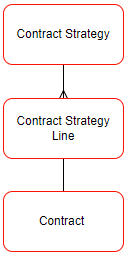
Contract Strategy provides the ability to define TMS contracts by service type at different levels and apply them in the context of a specific customer. This makes it possible to differentiate with much less specific contracts and to create a specific Contract with a number of main contracts for a wide range of customers. This makes it possible, for example, to define a number of standard contracts by country, lane or surcharge type and bring them together in a contract strategy for a specific customer.
By applying Contract Strategy performance on calculating revenue on Contracts can be improved. Contract Strategy can be applied on both Customer(s) as well as vendor(s), specific, group or all.
Contract Strategy works with the contract structure already in place. When revenues are calculated for a TMS document, the system will first determine whether a contract strategy exists. If not the standard TMS contract functionality is invoked.
Tip
- When using Contract Strategy the field: Contract Strategy Nos. on the page: Transport Setup, Tab: Contract Strategy. must be set.
- Logging on determining revenues when using Contract Strategies can be enabled. This gives users insight into determining which contract strategies, contracts, contract rules and contract detail rules apply. See the setting: Contract Strategy Logging on the page: Transport Setup, Tab: Contract Strategy. To open the logging, choose Related > Contract Strategy Logging on the order.
How TMS finds and applies a contract strategy
When TMS calculates revenue for an order, it uses the bill-to customer of the order. For costs on a trip it uses the vendor. TMS looks for a contract strategy that is valid on the work date, and it takes the first match in this order:
- A strategy for the customer (or vendor) itself.
- A strategy with source type Customer (or Vendor) without a source number.
- A strategy for the customer price group (or vendor price group) of the customer.
- A strategy with source type Customer Price Group (or Vendor Price Group) without a source number.
- A strategy for All Customers (or All Vendors).
If TMS finds no contract strategy, it uses the standard contract logic, unless No Cust. contract fallback when using Contract Strategy (or the vendor equivalent) is enabled in Transport Setup. In that case, no revenue is determined.
If TMS finds a strategy, it removes the existing revenue lines (after confirmation; how manual lines are handled depends on Rate Calculation With Manual Lines in Transport Setup) and creates new lines by working through the strategy lines in order of Priority. A line with priority 0 is ignored. For each line, TMS checks the following:
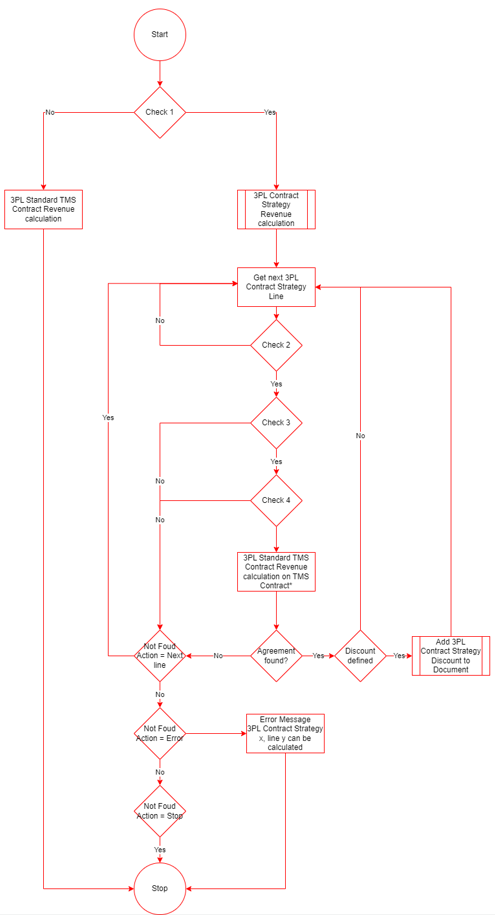
- Valid From Date and Valid To Date: The date that applies falls within the validity period of the line.
- Table filter: The document header of the order or trip falls within the table filter of the line.
- Criteria function set: The criteria function set of the line returns true.
- Agreement lines: TMS looks for matching detail lines in the linked contract, limited by the line type and service number of the strategy line.
What TMS does next depends on the result:
- Found Action (a matching detail line is found): Next Line continues with the next strategy line. Skip Same Type skips the remaining lines of the same line type, which is useful when each line represents a different destination.
- Not Found Action (no detail line is found): Next Line continues, Stop stops the evaluation, and Error raises an error.
General contract strategy
A contract strategy can refer to a general contract strategy. Use this to keep a generic set of contracts for all customers and a small strategy with the agreements that are specific to one customer. The field Apply General Strategy determines when the general strategy is used:
- Apply When No Details Found: TMS applies the general strategy if the strategy doesn't create revenue lines.
- Apply Always: TMS applies the general strategy after the strategy, even if it did create revenue lines.
- Apply Never: TMS doesn't apply the general strategy.
A general strategy can refer to yet another general strategy. TMS continues until revenue lines are created or the chain ends.
Functionality
Tabs
The Contract Strategy page consists of a number of tabs. Depending on the personalization settings, not all tabs are shown automatically to each user or role.
| Name | Description |
|---|---|
| General | Contains the general information on a Contract Strategy |
| Transport Revenue & Costs | Each line must always be linked to a Contract. |
Keep surcharge lines when several contract lines apply
Use this when the same service has more than one surcharge contract detail line, for example one line for distances over 50 km and one for distances under 50 km, and you run Execute Contract Strategy on an order.
By default, the system removes the surcharge revenue lines it already calculated for every contract it evaluates, so only the surcharge from the last evaluated contract remains. As a result, a surcharge can go missing even though its table filter matches the order.
To keep the surcharge lines from all evaluated contracts:
- Choose the
 icon, enter Transport Setup, and then choose the related link.
 - On the General tab, in the Contract Strategy group, turn on Keep Surcharge Lines.
Note
Keep Surcharge Lines is turned off by default. It applies only to contract detail lines with the line type Surcharge. Lines with the line type Transport or Service already behave this way.
Related information
Learn More
In Boltrics Academy we provide you with this e-learning